
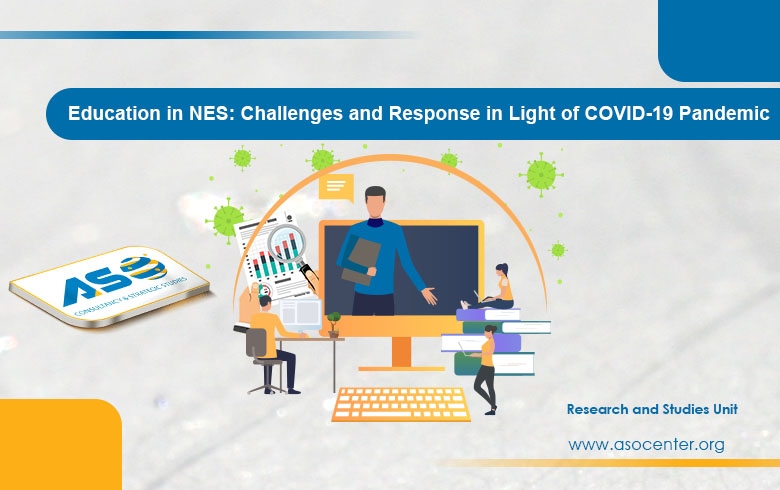
Education in NES (Challenges and Response in light of COVID-19 Pandemic)
2020-08-30
Coronavirus pandemic - with no doubt – ceased life cycle in the service, social and probably political institutions in the world, it also closed border, cities and towns gates and resulted in considerable financial damage in both private and public sectors. It revealed how fragile the health and medical systems in most world countries are.
With the rapid outbreak of the virus, which has become threatening larger sectors of life and larger number of people, the education sector in Syria has become the most problematic issue that needs rapid solutions, while ensuring the availability of health services to educational cadres and students. For Syria is still one of the states that is incapable to contain coronavirus pandemic, with the continuity of military operations all across the state and targeting educational and health centres in the operations as well as the continuity of Turkish military forces against the regions in NES.
The alignment of Coronavirus outbreak with the climax of the educational year in most world states, including the areas of the Autonomous Administration control has made the task of finding temporary and effective solutions that aid to end the school year without hindrance, especially when these states were not previously prepared for the E-learning mechanism, which was not within the priorities of developing the institutional and educational curricula as is the case with the Education Authority of the Autonomous Administration in NES.
Beside these obstacles, that hinders solutions in the Autonomous Administration regions in NES, the curfew imposed by the Autonomous Administration over the educational sector and the absence of compatibility between the Autonomous Administration and the Syrian regime in this aspect, the absence of technical and logistic support of the international organizations to the Autonomous Administration in this aspect, the continuous Turkish military attacks on NES, that targets the educational institutions, schools and civilians in many cases, also the lack of consensus and experience in the educational curricula, the existence of two educational curricula in NES, the different cultural and social nature among the components of NES and the political disputes, make an additional hindrance to the development of education in the region.
Table of Contents:
Introduction:
Executive Summary:
The Reality of the Educational Sector in Syria:
The Reality of the Educational Sector in NES:
Mechanisms for Implementing E-Learning in NES:
Conclusions and Recommendations:
1- Coordination for Free Access to Information:
2- Coordination to Secure Assistance:
3- Financial Support for Students:
4- Coordination of Awareness Campaigns:
5- Coordination for Advocacy Campaigns:
References:
To read the full report, please click on download
Download
Withdrawal Statement
Issued by ASO Center for Consultancy and Strategic Studies, from Madaniya Platform ASO Center for Consultancy and Strategic Studies hereby announces its complete withdrawal from...
Read more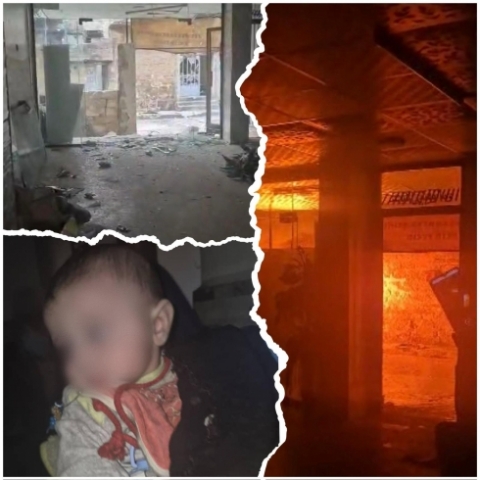
Strong Condemnation and Urgent Appeal for Immediate Intervention to Halt the Targeting and Siege of Khaled Fajr Hospital in Sheikh Maqsoud – Aleppo
We, the undersigned civil society organizations, hold the Syrian Transitional Government fully responsible for the ongoing and direct targeting of Khaled Fajr Hospital—the sole medical...
Read more
Communiqué Syrian Humanitarian Action & Recovery Conference Local solutions for lasting impact
The Civil Society Organizations Platform in North and East Syria (NGO Platform) participated in the Humanitarian Work and Recovery Conference for Syria, which brought together...
Read more